
Ancient Greece
From early city-states to ideas that travelled across centuries.
A world of cities and islands
Ancient Greece was not one single state. It was a network of city-states, islands and communities connected by the sea, language and shared traditions. Athens, Sparta, Corinth and Thebes each developed their own identity.
Athens and public life
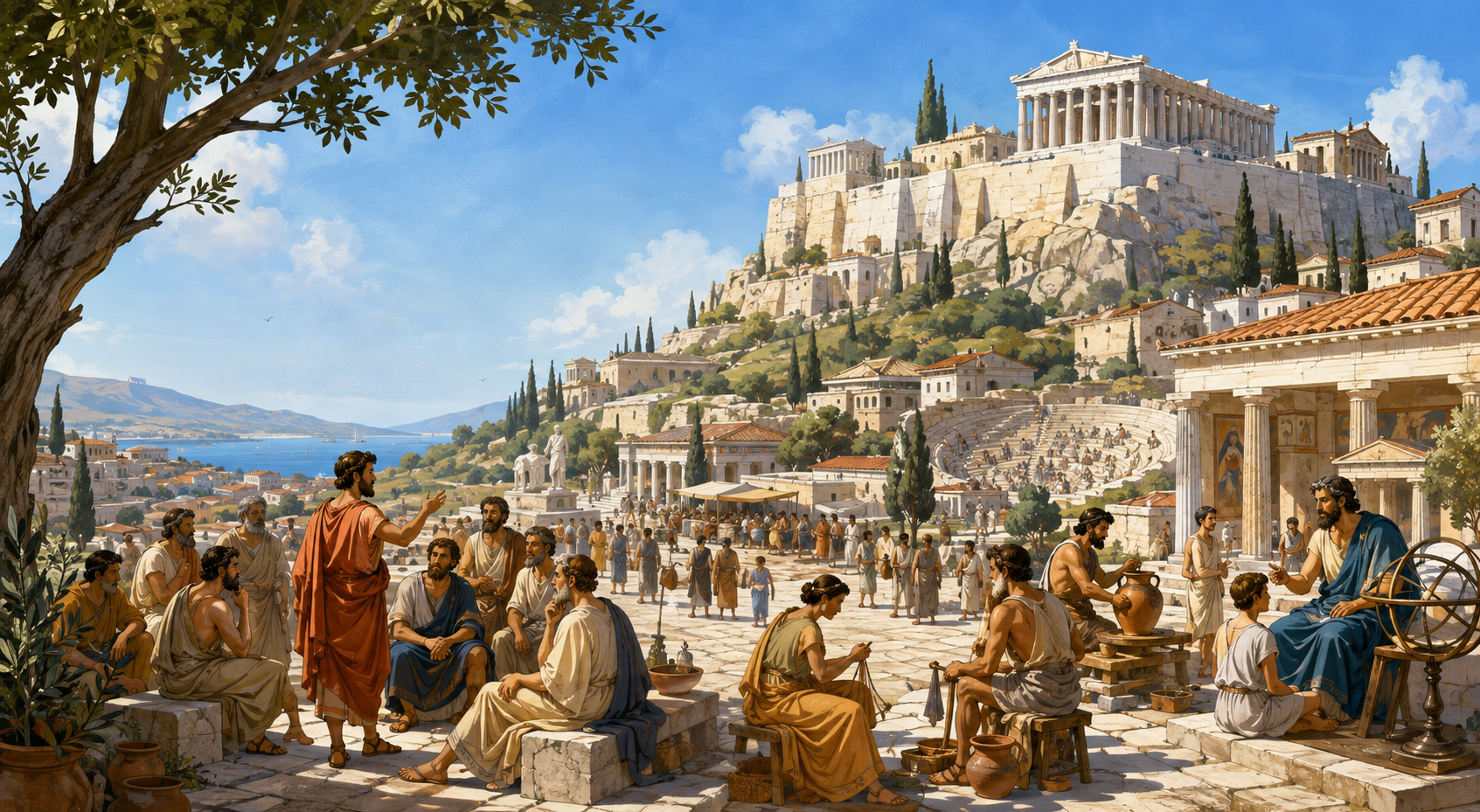
The agora was a place for meeting, trade and debate. Athenian democracy involved only part of the population, yet it introduced the idea that public decisions could be discussed by citizens.
Thought, art and knowledge
Socrates, Plato and Aristotle asked lasting questions about justice, knowledge and politics. Theatre, architecture, mathematics and science became ways to observe and interpret reality.
From Greece to the Mediterranean
After the age of the city-states, Alexander the Great and the Hellenistic kingdoms spread Greek language, art and knowledge across a wide region, where they met other cultures.
A wider story
Between the second and first millennia BCE, the Aegean world saw different cultures flourish, from Minoan communities in Crete to Mycenaean centres on the mainland. After a period of crisis, the city-states became autonomous communities with their own laws, institutions and religious traditions. The sea connected ports, trade and ideas. Athens developed participatory institutions for its citizens, while Sparta organised public life around military training and discipline. In the fifth century BCE, the Persian Wars brought many cities together against a common enemy; afterwards Athens entered a remarkable age of theatre, philosophy, architecture and public debate. Rivalry between the city-states then led to the Peloponnesian War and a fragile balance of power. In the fourth century BCE, Philip II of Macedon expanded his influence and Alexander the Great carried Greek language and culture towards Egypt and Asia. The Hellenistic kingdoms that followed combined Greek institutions with local traditions, making the Greek world more Mediterranean and cosmopolitan. Rome later absorbed these territories but continued to learn from their art, philosophy and literature. Ancient Greece is therefore not one simple story: it is a history of different communities, encounters, conflicts and exchanges whose traces still endure.